
Columbia SPS Community Explores the Future of AI at Ai4 Conference
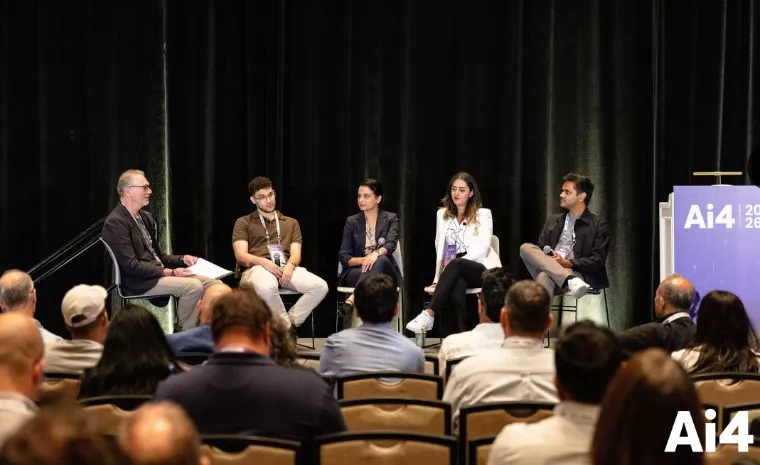
Image Credit: Rootcause.ai, originally posted on LinkedIn https://lnkd.in/p/giUxbw5s
Faculty, alumni, and students joined thousands of industry leaders in Las Vegas to examine emerging technologies, the future of work, and the growing importance of human-centered AI.
Columbia University School of Professional Studies (SPS) faculty, alumni, and current students joined approximately 12,000 attendees at the Ai4 Conference, held in August at the Venetian in Las Vegas. The conference brought together leading researchers, technology executives, entrepreneurs, and industry professionals to explore the latest developments in artificial intelligence and their implications for business and society.
Across keynote presentations, panel discussions, and an expansive exhibition hall, several themes emerged: the rapid development of AI agents, uncertainty surrounding the technology’s economic impact, and the increasing importance of human-centered design and subject matter expertise.
Industry Leaders Discuss the Future of AI
One of the conference’s most anticipated sessions featured three prominent AI researchers: Geoffrey Hinton, Fei-Fei Li, and Andrew Ng. Their discussion explored a wide range of perspectives on AI’s future, highlighting both the opportunities and the risks associated with its rapid advancement.
Other notable speakers included entrepreneur and former presidential candidate Andrew Yang, who examined AI’s potential effects on the labor market, capital markets, and the distribution of economic benefits. Former Intel CEO Pat Gelsinger addressed the infrastructure supporting AI development, including data centers, semiconductor technology, and future applications.
Megs Shah, CEO of the Parosol Cooperative, an organization dedicated to protecting lives through technology, presented the organization’s work on Ruth, a digital AI guardian. The session offered an example of how AI can be developed to address human needs and deliver meaningful social impact. Shah is scheduled to join an upcoming SPS AI Salon conversation later this academic year.
Presentations also explored the evolving commercial AI landscape. Mistral, for example, discussed its go-to-market strategy and approach to offering specialized AI models at different price points, illustrating how companies are adapting their products to meet diverse customer needs.
Emerging Technologies and Industry Conversations
The conference’s exhibition hall featured approximately 400 booths representing major technology companies, consulting firms, and startups. AI agents were a dominant theme, with numerous exhibitors showcasing platforms for agent development, deployment, and monitoring. Robotics also had a significant presence, reflecting growing interest in AI applications beyond software.
Outside the formal sessions, conversations among attendees addressed open-source and open-weight models, practical AI applications, and broader questions about the technology’s economic and societal implications.
Together, these discussions reflected an industry moving rapidly toward new capabilities while continuing to grapple with questions about their implementation and long-term effects.
Key Takeaways: Putting People at the Center of AI
A central takeaway from the conference echoed the theme of a recent SPS Frame Your Future event, “No One Knows.” Despite rapid technological progress, significant uncertainty remains about AI’s effects on employment, infrastructure costs, return on investment, and the pace of adoption.
Amid that uncertainty, two priorities stood out: human-centered design and subject matter expertise.
As AI capabilities expand, identifying the right problems to solve and placing human needs at the center of technological development are becoming increasingly important. Equally essential is the expertise required to understand existing workflows, evaluate accuracy, and determine where AI can deliver meaningful improvements.
For the SPS community, these themes reinforce the importance of combining emerging technologies with specialized knowledge and a human-centered approach to innovation.